PokerBotAI review: first on my list, with real catches
I rank PokerBotAI first on this site because it finished ahead of every rule-based bot I ran, but the margin over breaking even is small enough to be noise at this sample size, and the thing needs babysitting. On my eight criteria it lands at 6.6 / 10 Strong on room coverage and a genuine neural engine, weak on setup friction, cost transparency, and reliability. It runs an Android emulator with a proprietary cloud AI, supports PPPoker natively plus a long list of club apps, and sells as a one-time license plus a per-hand "fuel" meter (the vendor's docs put the license start around $700, checked November 2026). I'd reach for it first among the bots reviewed here. It's not a money printer, and you need to watch for mid-session hangs. Facts below come from PokerBotAI's own public pages and my own bench at micro-stakes on PPPoker.
My eight-criterion score
I score every product on the same eight dimensions before any bench result decides the ranking. For the bots I actually ran, the micro-stakes PPPoker result is what sorts them; the dimensions explain why. Here's how PokerBotAI lands, out of ten per dimension. These are my judgments, not the vendor's.
| Criterion | Score | Why |
|---|---|---|
| Supported rooms | 9 | Native PPPoker plus a broad list of club and Asian apps, and the GG family. Wider reach than the OpenHoldem family I tested against. |
| Technical stack | 7 | Android emulator, a modified client, a traffic sniffer, and a proprietary cloud model. Modern for this market, but heavy and dependent on their servers staying up. |
| Detection risk | 6 | An emulator-plus-sniffer stack has a real surface, and detection is a risk you manage, not one anyone has solved. My account wasn't flagged during the run, which is not a promise it won't be. |
| Supported game types | 8 | The vendor lists NLH and PLO, plus OFC and MTT. I only pushed it on short-handed NLH, where it was comfortable. |
| Setup friction | 5 | An emulator and a client to run, plus an operator who checks on it. This is not install-and-forget. Most buyers underestimate the supervision it needs. |
| Pricing | 5 | One-time license plus metered fuel per hand. The meter is an ongoing cost that grows with your volume, and the exact license price comes only by quote. |
| Support and updates | 7 | A public releases page and docs that get revised. Active, at least on the surface I can see from outside. |
| Public trust and reviews | 6 | Most of the praise is vendor-hosted, independent coverage is thin, and my own read is positive but noisy. I'd weight it lightly. |
Averaged, that's 6.6. A first-place score in the low sevens tells you more about the field than the product: the rule-based bots I ran were losing money, so "the one that wasn't" clears a low bar.
What PokerBotAI actually is
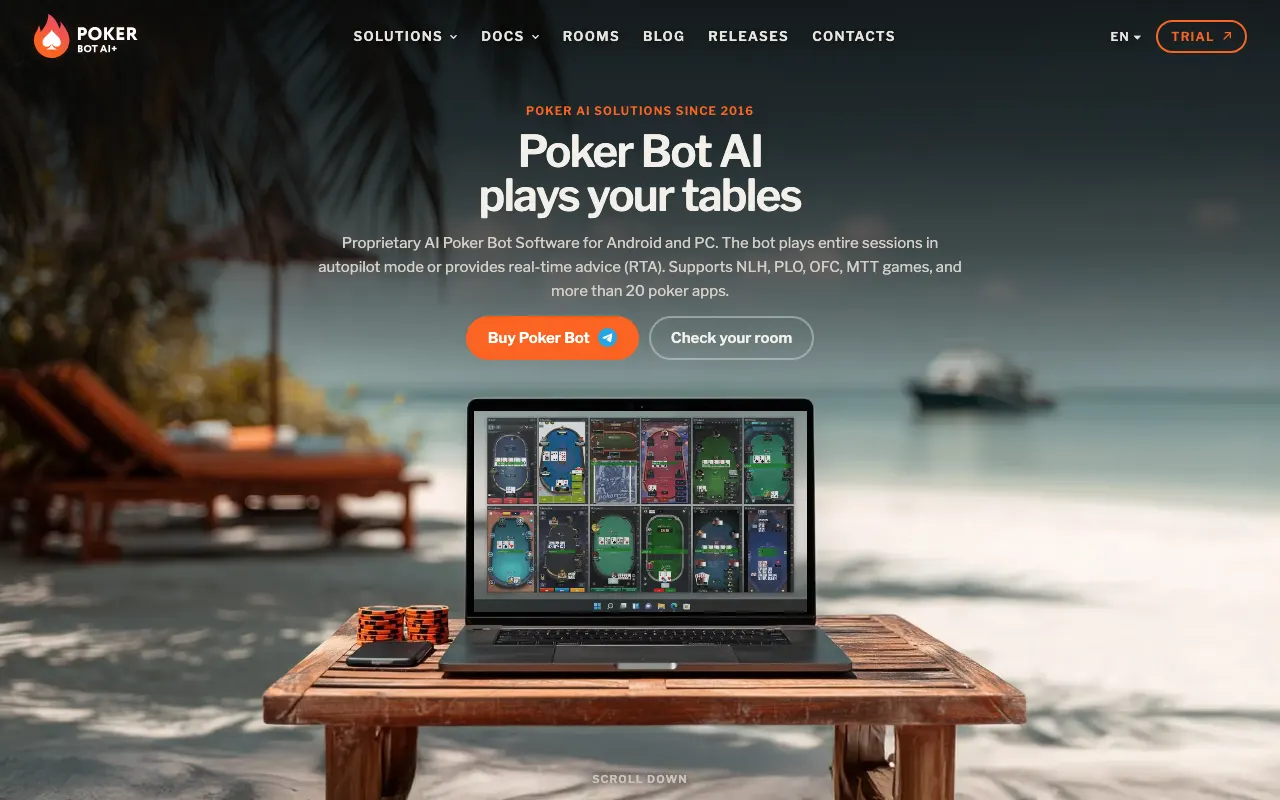
Stripped of the marketing, PokerBotAI is an Android-emulator bot with the decision-making moved to the vendor's servers. The client runs the poker app inside an emulator, a sniffer reads the table state, and a proprietary cloud model returns the play. The vendor pitches two modes: full autopilot, where it plays sessions for you, and real-time advice (RTA), where it feeds you the move and you click. It advertises support for more than twenty poker apps.
Because the intelligence sits in the cloud rather than in a downloadable strategy file, you don't tune and own an OpenHoldem profile. You rent access to a model and feed it hands. That's why it plays better than the script-based bots, and also why it keeps costing you money after you've "bought" it. On rooms, native PPPoker is the one I'd trust most, since that's where I ran it; the longer app list on their site I can't vouch for from the bench, only report.
What my bench showed
I ran several commercial bots head to head at micro-stakes on PPPoker, low on purpose so the per-hand fuel cost on the metered products didn't swamp the result. PokerBotAI came out ahead of every rule-based bot in that run, all of which lost. It finished ahead of the scripted field, with a margin over zero small enough to be noise at this sample. I'm not going to dress that up as a decisive win, because at this stake and sample it isn't one.
What it did do, that the scripted bots couldn't, was play hands that looked like a competent human's rather than a profile's. The OpenHoldem-family bots telegraph themselves with rigid lines; this one varied. I can't tell you whether that holds up at higher stakes against better regs. I didn't test there. Anyone who claims a micro-stakes bench predicts mid-stakes results is guessing.
The price is a license plus a meter
PokerBotAI doesn't sell a flat product. Per the vendor's own pricing doc (how much do poker bots cost, updated October 2026, checked by me November 2026), the license starts around $700, and the homepage describes the model as a one-time license plus "fuel", an internal currency charged per hand you play and priced by room and stake. There are no monthly subscriptions and no cut of your winnings, which is genuinely better than the profit-share deals some vendors push.
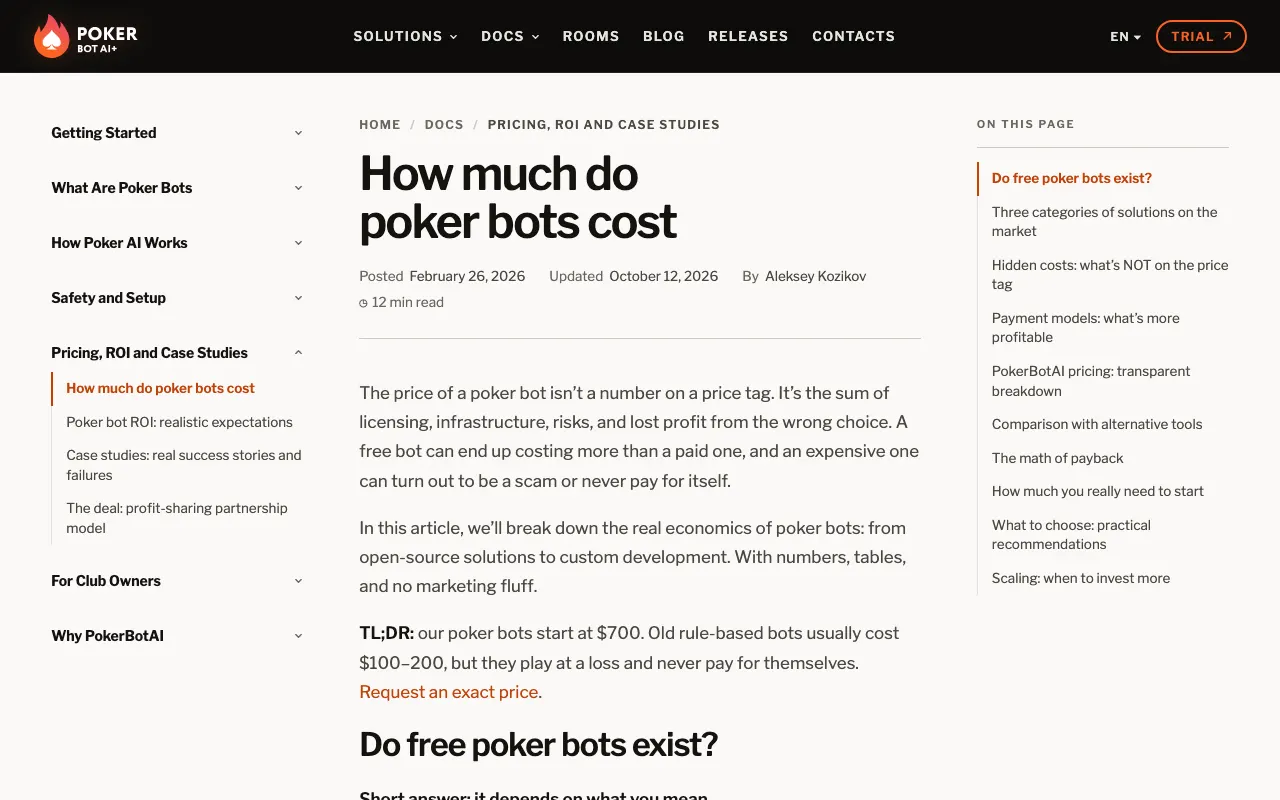
Fuel means your cost scales with how much you play, and the vendor updates fuel prices monthly, so your running cost isn't fixed at purchase. High-volume grinders face larger fuel bills. Buyers testing the bot need to watch those charges too. The exact license price isn't posted. You contact them for a quote scoped to your rooms and modes. I'd treat the "$700 start" as a floor, not the bill.
The catches I'd want a buyer to know
This is where an honest review earns its keep, so here's what I'd flag before anyone spends:
- It hangs. On my run it occasionally stalled or crashed and needed me to step in. An unattended session that freezes mid-hand can drop into fold mode or sit there, and either way it's leaking money while you're not looking.
- It needs an operator. The autopilot pitch undersells how much supervision this wants. Realistically you're watching it, not leaving it overnight. Budget your own time as part of the cost.
- Detection is never off the table. The emulator-and-sniffer approach has a detection surface, and club admins act on robotic timing and player complaints. It wasn't flagged in my run; that's a data point, not a promise, and anyone selling you a bot that can't be caught is lying.
- The cost keeps coming. Costs don't end with the license. You also pay for metered fuel and spend time supervising it.
It isn't a scam. It works, unlike most of the field, though its marketing glosses over the running costs and failure modes.
How it stacks up against the bots I ran
Here's the same comparison I keep on the home page, for the products I actually benched at micro-stakes on PPPoker. The result column is qualitative on purpose; I'm not publishing per-hand figures that would turn a rough bench into false precision.
| Product | Tech | PPPoker support | Result over 26,000+ hands | Verdict |
|---|---|---|---|---|
| PokerBotAI | Android emulator + modified client + traffic sniffer + proprietary cloud AI | Native (primary supported room) | Positive | Finished ahead of every rule-based bot, but the margin over zero is small enough to be noise at this sample size. Occasional hangs/crashes that require operator attention. |
| Warbot | OpenHoldem-based, packaged with custom profiles | Native | Negative | Detected and banned. Crashes occasionally and auto-folds. Realistic ceiling is micro/low stakes per their own FAQ. |
| Shanky / BonusBots | Proprietary Shanky engine since 2007 + PPL profiles | Native | Negative | Works mechanically but the stock profiles are micro-stakes territory. Account banned. |
| 3upgaming | Vendor-installed VM, opaque engine, marketing-heavy | Native (PPPoker is in their list) | Deeply negative | Dumps chips. Scam by my measure. Zero technical evidence of anti-detection or profitability behind the marketing. |
Three products lost money, one scored negative badly enough that I'd call it a scam, and PokerBotAI was the one that didn't lose.
Who should bother, and who shouldn't
PokerBotAI is worth a look if you're a hands-on operator who'll actually supervise it, you play rooms it supports natively, and you treat the license-plus-fuel cost as an expense to beat, not a promised payout. If you want to buy software, walk away, and collect money, this isn't it, and nothing in this category is.
If you're not willing to sit with it during sessions, skip it. Hangs and fold-outs turn into losses when no one's watching. Its poker isn't its biggest weakness. The supervision it needs exceeds what its autopilot marketing admits.
Questions buyers keep asking
Did PokerBotAI win your test? It placed first among the bots I ran, because it was the only one that didn't lose money at micro-stakes PPPoker. But the margin over breaking even was small enough to be noise at that sample, so I wouldn't call it a decisive win, just the only one of the bots I ran that didn't lose money.
How much does it really cost? A one-time license the vendor's docs start around $700 (checked November 2026), plus metered "fuel" charged per hand and repriced monthly. The license is a quote scoped to your rooms, so treat the start figure as a floor and the fuel as an ongoing cost.
Can it get my account banned? Yes, in principle. It runs through an emulator with a traffic sniffer, which has a detection surface, and clubs act on timing and complaints. It wasn't flagged in my run, which proves nothing about yours.
Is it better than Shanky or Warbot? On my bench, yes. Those lost and it didn't. The gap is more about the scripted bots being weak than about PokerBotAI being dominant.
Can I leave it running unattended? I wouldn't. It hangs often enough that an unwatched session can bleed, so plan to operate it rather than set it and forget it.